Tuesday, 9 August 2011

ICT’s role in academic management.


In UniMAP, ICT is not only used to support numerous administrative requirements, but also to provide a comprehensive environment to sustain teaching-learning processes. The UniMAP ICT Centre is established to plan, develop, implement, and maintain the appropriate ICT infrastructure such as the University Information System and Campus Communication Network. The ICT Centre also provides consultancy and advisory services in this area, apart from helping to inculcate an overall ICT culture within the University
                                  
To date, UniMAP has apportioned as much as 15% of its management budget to build its ICT infrastructure, of which a substantial portion of this is solely to support teaching-learning interests. The University e-learning project makes up a big portion of this expenditure.

With facilities comparable to those in Putrajaya, UniMAP’s ICT infrastructure has gained the accolades of several external parties, including MAMPU. The k-Attendance System developed by the University was awarded the silver medal at the Institutions of Higher Learning Research and Development Exposition organised by the Ministry of Higher Learning in August 2005. This totally homegrown system has also attracted the attention of several ICT users from Europe and the Middle East, who saw added potential in its application when the system was demonstrated in Geneva in April, 2006.
 

UniMAP’s e-learning project


In UniMAP, all courses are conducted exclusively on-campus. E-learning here is defined as the delivery of selected courses or topics within some courses over the internet, which aims to enhance the customary face-to-face teaching-learning processes. It aims to supplement conventional, face-to-face teaching-learning methods.

It has to be noted that prior to the ‘official’ e-learning project described below, since the very beginning, the ICT infrastructure in the University has been sufficient to support the uploading of lecture notes onto the portal..

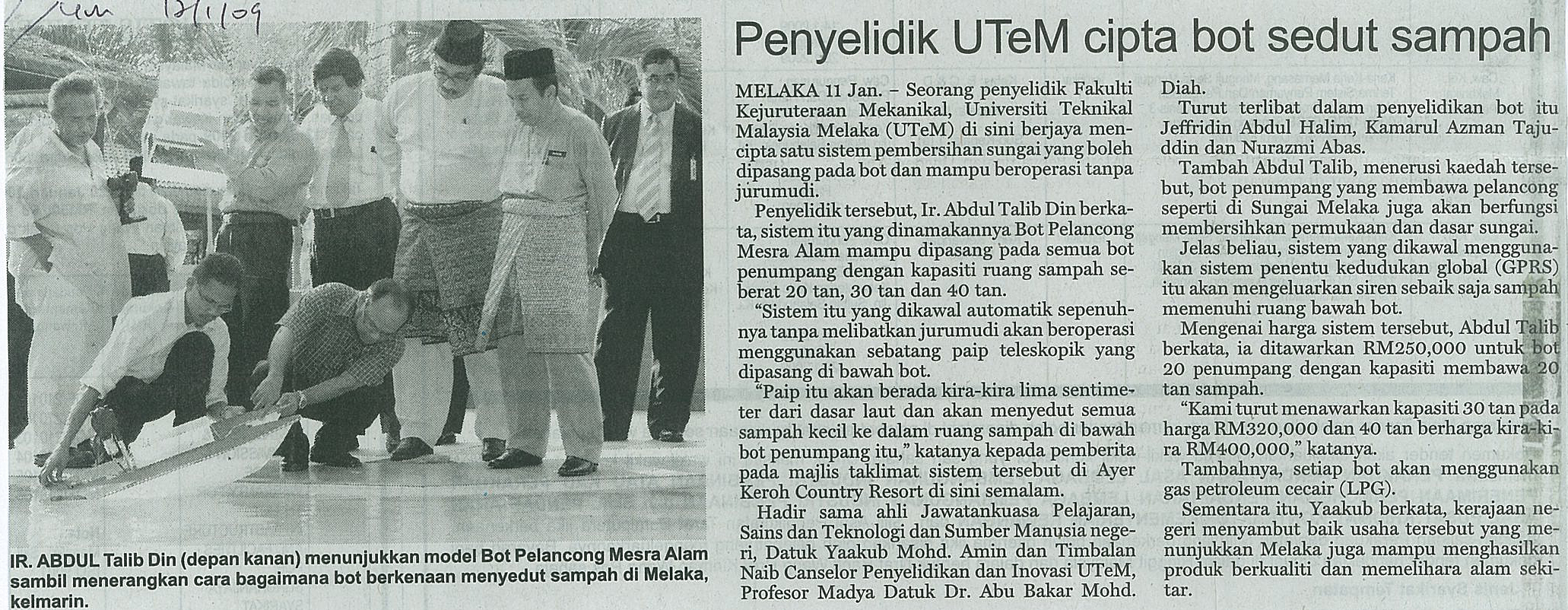
UTeM researchers create suction boat trash


UTeM In Newspapers


ARTICLE TITLE
:Penyelidik UTeM Cipta Bot
NEWSPAPER RELEASE
:Utusan Malaysia
DATE
:12.01.09

Producing qualified graduates with first class facilities


Workplace simulation with first class facilities at KLMU
Providing a world class education has always been the prime objective of the Kuala Lumpur Metropolitan University College (KLMUC). This can be measured by its almost 100% student employment rate upon graduation.

At KLMU, students are not only exposed to theories but are trained to balance practical aspects with relevant experiences based on a real work environment. To ensure that all students understand the subject they study, each classroom setting is focused on developing a clear and comprehensible presentation of the subject matter. Furthermore, students are assessed through a continual evaluation process that is based on learning outcomes.

The lecturers play a vital role in the student’s learning processes via the mentor-mentee programme that fosters a positive influence during the course. Classes are intentionally small to ensure all students receive adequate guidance while their confidence is being nurtured.

KLMU has invested millions on various modern facilities, including an auditorium, a computer laboratory with broadband connection, art studio, cyberzones, conferences, gymnasium, cafeteria, student activity lounge, hospital simulation ward, health science laboratory, and a fully equipped hospitality facility.

Additionally, KLMU has installed CCTVs within its premises for added security.

Updated: 11:33AM Fri, The Sun, 21 Jan 2011

Thursday, 4 August 2011

Turnitin Turns You In


Staff getting a feel of the software
Pic_2Before you think of copying that sentence from some obscure research paper and calling it your own, think again: a software used by Monash University Sunway campus academics will catch you.

Using the “originality check”, a function of the Turnitin software, lecturers are able to tell whether an assignment has been plagiarised.

Plagiarism can be detected between five and 30 minutes, says Dr R. Nagasundara Ramanan, a School of Engineering Lecturer who gave a briefing on Turnitin.

“The software enables the educator to match description for cross-checking to detect plagiarism. For educators, the software saves time to evaluate a paper in terms of writing and citations,” he explained.


Dr R. Nagasundara Ramanan encourages more academics to use the Turnitin software.


Pic_1Dr Ramanan recommended Turnitin’s use to academics, which reduced the time for academics to locate good versus bad assignments.

“In some cases, a paper can be 89 per cent plagiarised,” he said. “Once students know that academics are using this facility, they will make better effort with the assignment,” he added.

According to Mr Edmund Turner, Director of Information Technology Services, four Schools at the Sunway campus are currently using the software: School of Business, School of Engineering, Jeffrey Cheah School of Medicine and Health Sciences, and School of Science.

Story by Shamini Darshni with pictures by Michelle Kiob 
16 May 2011


VIEW: http://www.monash.edu.my/advancement/marketing/2011/Turnitin-Turns-You-In.html


First Regional Research Network on Non-Communicable Diseases Launched


Pic_1
Professor Brian Oldenburg of Monash University Australia YBhg Dr Lokman Hakim Sulaiman and Prof Dato Dr Anuar Zaini Md Zain taking questions from the media.
Monash University and partners in Sri Lanka, India and the United States have received over USD1 million from the US’ National Institutes of Health (NIH) to establish the first regional research network on non-communicable diseases (NCDs).
The Asian Collaboration for Excellence in Non-Communicable Disease (ASCEND) Research Network was launched today by Deputy Director-General of Health (Public Health) YBhg Dr Lokman Hakim Sulaiman.
The ASCEND Research Network aims to build a regional network of researchers and research institutions who will be at the forefront of research in the area of non-communicable disease prevention and management in Asia.
The funding was awarded by the Fogarty International Centre of the NIH through its Millennium Promise Award.
In his address, Dr Lokman said that ignoring NCDs may compromise national or regional health care systems that were already weak and contribute to increased health disparities.

This, he said, was of particular concern as risk factors of NCDs tended to occur among poorer populations in low and medium income countries.

“Failure is not an option. Success in averting this crisis is essential to ensuring the present generation of children, as well as the next, have the chance to live long and healthy lives,” he said.

Non-communicable diseases threaten the wellbeing and quality of life of millions around the world. Chronic non-communicable diseases including cardiovascular, cancer, respiratory and diabetes are among the fastest growing diseases on the planet.

With the grant, the Sunway and Melbourne campuses of Monash University, together with partners Sree Chitra Tirunal Institute for Medical Sciences & Technology (India), the University of Colombo (Sri Lanka) and the University of North Carolina (US), are working together to provide high quality research training to over 40 researchers in Asia over five years.

Today, the launch of the ASCEND Research Network commenced with the first cohort of 25 trainees from India, Sri Lanka, China and Malaysia participating in a three-week intensive program in non-communicable diseases, hosted by the Jeffrey Cheah School of Medicine and Health Sciences at Monash.
Pic_2
Dr Lokman Hakim Sulaiman with assistance from Prof Dato Dr Anuar Zaini Md Zain marking the launch of the ASCEND Regional Network .
Following this, they will continue to develop their own research projects targeting non-communicable disease prevention and management in their own country.

Monash University Australia’s Professor Brian Oldenburg, who is also ASCEND Regional Network Program Director said that program saw a dynamic mix of trainees.
Pic_3
ASCEND trainees are made up of researchers from India (nine) Sri Lanka (seven) Malaysia (eight) and China (one).
“ASCEND is just a beginning. Over the next three weeks, you will discuss chronic conditions such as important health conditions for all our countries,” he told the trainees, adding the program would also foster effective exchange and interaction.
“If we fail in this endeavour, there would be dire consequences for our health systems, and our lives.”
Head of the Jeffrey Cheah School of Medicine and Health Sciences Prof Dato’ Dr Anuar Zaini Md Zain said he hoped more researchers from local public and private universities and the Ministry of Health would take part in the program.
“The epidemic in the Asia Pacific region will have untold consequences and place an economic burden regionally and globally if we do not address it now,” he said.

The projects will be supervised and mentored by global experts in the field. Trainees will be supported over 18 months of the program through online web-based learning, peer support and mentoring.

The contemporary approach to global learning will allow trainees to participate in interactive tutorials, discussions and learning from anywhere in the world.


Story and pictures by Shamini Darshni  
15 June 2011
VIEW: http://www.monash.edu.my/advancement/marketing/2011/First-Regional-Research-Network-on-Non-Communicable-Diseases-Launched.html

Malaysia Digital Innovation Centre takes learning to a new dimension

Limkokwing University of Creative Technology
Malaysia Digital Innovation Centre takes learning to a new dimension


Dato Seri Khaled Nordin executing a ‘touch screen’ launch of the Malaysia Digital Innovation Centre watched by University President Tan Sri Lim Kok Wing and Dato’ Timothy Lim Jr, Head of the World Wide Web Domination, the University’s official website, which attracted over 200 million hits from 220 countries and territories annually.

Technology keeps changing, accelerating with new provisions that shorten the time we take to do things. Today we can actually print a book within a few minutes and we can immediately capture a video in 3D format. For those wanting to build interesting ways to connect with their target audiences these technologies open the door for unlimited creativity.


Every year something new hits the market and starts a consumer frenzy.
So while industries grapple with the means to beat the competition with new gimmicks and advertising, they need skills to manage the new technology and create the content they seek. 
The Limkokwing University has created new partnerships with high end digital technology providers through a new initiative called the Malaysia Digital Innovation Centre.

Bringing industry into university

Already embedded within the University is INDUSITY – a revolutionary concept that merges the best of the University with the best of the Industry to bring innovative knowledge, skills and application to Limkokwing students right into the campus.
MDIC too works along this creative pathway by working closely with the Ministry of Higher Education with the mission to raise the standards and quality of the nation’s education system, which is to produce high calibre human capital to move industry up the value chain.

From middle income to high income


The Centre’s thrust responds to the Prime Minister’s transformation programme, which places high priority on education as the vehicle to move from middle-income to high income status by 2020.
Minister of Higher Education Dato’ Seri Mohamed Khaled Nordin, in launching the Centre recently, envisioned MDIC as an excellent “infrastructure” to push the migration of skilled talents into the industry.


The Higher Education Minister being ‘crooned’ by the Limkokwing International Choir lead singer, Siti Hasreena Rosli soon after the official launch of the centre. Others in the picture include Tan Sri Lim and senior University officials.
“I believe that a world-class digital infrastructure like this is fundamental and part of the ecosystem to support an innovation-led economy, which has become the aspiration of Malaysia today. Its strong focus on innovation will definitely take education to a new level as it provides the vehicle designed to connect the high end of digital technology to creativity and content creation.”

Taking creativity to new levels

The creation of MDIC is in direct response to the Prime Minister’s call for norm-breaking efforts to engineer human capital that is wired to the future. For over 20 years, the University has played a pivotal role in promoting creativity and innovation as the engine of progress for the country, a role it continues with breakthrough ideas much like the digital innovation centre. 
Dato’ Seri Khaled, a strong advocate of creativity and innovation, believes quality human capital is the way to make the government’s transformation policy a success.
“In today’s world, this has to be done by intensifying the nation’s knowledge and innovation capability. In today’s world, knowledge and innovation have become the keys to progress and growth. Knowledge increasingly defines the line between wealth and poverty and between human fulfillment and poverty. A country which is able to mobilise and spread knowledge can rise rapidly to new levels of development, help its citizens to prosper and more importantly, education is considered as the most important component in the dissemination of innovation.’

Designing the future


MDIC is timely considering Malaysia’s efforts to propel creativity and innovation in every sphere of its development process, particularly in the local digital industry. It caters for those with a passion to acquire the best in digital technology and who want to be future-ready to handle new industry challenges taking place with every tick of the clock. 
The innovation Centre offers internationally-recognised digital-friendly programmes:
  • Digital Imaging
  • Interactive & Multimedia Design
  • Animation & Multimedia Design
  • Digital e-Games
  • Design Innovation
  • Visual Communication
  • Web Design & Technology
  • Creative Multimedia
  • Sonic Design
  • Digital Film & Television
  • Digital Communication

Stimulating environment

The Malaysia Digital Innovation Centre houses state-of-the-art training facilities including:
  • High tech computer incubation rooms
  • Training and lecture theatres
  • 3D LED screen
  • Exhibition and conference
  • Corporate boardroom
  • Reception lounge and business facilities
  • Olympic-size swimming pool.

“This University is possibly the world’s largest digital content training facility. For this reason, this campus has become a talent hub for some of the brightest brains in the world. Here, high tech accelerators are created to generate high end products and services that are second to none in the country.”
Tan Sri Dato’ Sri Dr. Lim Kok Wing,
Founder President of Limkokwing University of Creative Technology
In his address at the launch of MDIC at the Cyberjaya campus, 18 July 2011

Discover MDIC

The Malaysia Digital Innovation Centre is one such accelerator to nurture the most imaginative and creative minds for creative industries, where essential test-beds are built to create new innovations for wealth-generation.

VIEW: http://www.limkokwing.net/media/news/malaysia_digital_innovation_centre_takes_learning_to_a_new_dimension/

Limkokwing creativity grooms ICT-savvy talents

Limkokwing University of Creative Technology


  • Limkokwing creativity grooms ICT-savvy talents
An advocate of creativity and innovation since the 1970s, the Limkokwing University of Creativity Technology (LUCT) is taking the lead by producing graduates equipped with the right skills and capabilities to drive the ICT industry and their careers.

ICE- a way of life

Information technology is very much a part of everyday life: the computer occupies a central position not only in business organisations but increasingly in fields as diverse as manufacturing to space exploration and banking.
This has created a wealth of opportunities for Malaysia, which is moving into a high-income and innovation-driven economy, one area that well-qualified ICT graduates are able to provide the momentum to propel it.

Geared for success

The LICT Faculty of Information and Communication Technology offers internationally-recognised BSc degrees including Mobile Computing, Games Technology and Business Information Technology, as well as postgraduates studies in Computer Networking and Communication. Delve into the exciting world of ICT where you will get to learn all you’ve ever wanted to know about:
  • Games Programming
  • Digital Modelling and Animation
  • Artificial Intelligence
  • Interactive Multimedia
  • Real-Time Systems
  • Internet Security Knowledge
  • Grid Computing

High-flying ICT careers

The programmes are tailored to ensure graduates are industry-ready and able to blend in with different cultures and nationalities, making them attractive to potential employers.
Some of the career options one would consider as an ICT graduate would be:

Chief Information Officer (CIO)A CIO heads the IT group within an organisation, and usually reports to the chief executive officer (CEO). You will be the visionary ICT leader, spearheading ambitious projects that will enhance the growth and business strategy of the organisation and will be responsible for the overall strategic direction and management of the organisation’s IT infrastructure.

Security AnalystAs the person ensuring the security of the organisation, you will have to be privy to security breaches and network intrusions. The guardian of the ICT hardware and software, you handle all security documentation and assess the suitability of new technologies on existing or planned systems.

Analyst ProgrammerThis role requires knowledge of a variety of programming languages. If you’re good at programming, you will enjoy installing, designing, modifying, testing and writing programmes, and supporting work teams and solving problems with software.

Blending the world’s diverse cultures

The Limkokwing campus in Cyberjaya is an experience unlike any other. Students from all over the world converge, making it a dynamic multicultural environment with 70% of the 9,000 students coming from over 160 countries worldwide.
The university has some 30,000 students studying in its 12 campuses in Botswana, Cambodia, China, Indonesia, Lesotho, Malaysia and the United Kingdom. A big part of its appeal is the university’s innovative brand of creative education that merges the best of East and West education.

Experience London

In a rapidly developing world, the learning experience today has to include exposing young people to global business trends and innovation.
London - one of the world’s most vibrant and lively cities - is the heart of Limkokwing’s Global Research Centre for Creativity and Innovation.
Located in the heart of thriving Piccadilly, the campus provides students a unique opportunity to cross over to nearby locations for research in business, design, multimedia or any other fields of study.
An ICT student now has an opportunity to graduate with two awards, one Asian and one British. This is an exclusive route for Limkokwing students to spend their final year or semester in London, enabling them to obtain a Limkokwing award and a second credential from Anglia Ruskin University of Cambridge or University of Gloucestershire, UK.

view: http://www.limkokwing.net/media/news/limkokwing_creativity_groomds_ict-savvy_talents/